FunXplore Chicken & Duck Coops for Real Backyards
FunXplore's poultry coops are wooden outdoor structures built for chickens, ducks, and quail that actually live outside — in rain, wind, and cold. Each model pairs an asphalt shingle roof with ventilated windows, pull-out cleaning trays, and a non-slip ramp, and the insulated builds add foam insulation through the walls for keepers in colder climates. These are sized for small backyard flocks: 1–3 birds, not a commercial operation.

All Four Coop Models at a Glance
PD-1031-Y Duck Coop Standard
See on Amazon
PD-1031W-Y Insulated Duck Coop
See on Amazon
PD-1032W-R Insulated Chicken Coop Red
See on Amazon
PD-1032-R Chicken Coop Standard Red
See on AmazonSee more products
Discover the full product lineup with current selection on Amazon.
All products on AmazonSide-by-Side Specs for All Four Models
All four coops share the same asphalt shingle roofing, ventilated windows, and pull-out tray system. The differences between them come down to dimensions, insulation, weight, and species-specific features like the nesting box.
| Model | Dimensions (L×W×H) | Weight | Insulated | Key Feature | Best For |
|---|---|---|---|---|---|
| Duck Coop Standard (PD-1031-Y) | 41.5×27.8×39.42 in | 59.9 lbs | No | Non-slip ramp, pull-out tray, asphalt roof | Ducks, chickens, quail in mild-winter climates |
| Duck Coop Insulated (PD-1031W-Y) | 41.7×27.8×39.5 in | 67.3 lbs | Yes | Foam-insulated walls, predator protection, non-slip ramp | Ducks, chickens, quail in cold-winter climates |
| Chicken Coop Standard (PD-1032-R) | 55.2×29.6×39.4 in | 74.6 lbs | No | Nesting box, removable PVC floor layer, pull-out tray | 1–2 laying hens or dual-purpose rabbit hutch, mild winters |
| Chicken Coop Insulated (PD-1032W-R) | 55.2×29.6×39.4 in | 81.3 lbs | Yes | Foam-insulated walls, nesting box, removable PVC floor layer | 1–2 laying hens in cold-winter climates; best overall build |
If you're in a climate with genuine winters and you're keeping laying hens, the insulated chicken coop (PD-1032W-R) is the most complete package in the line — the nesting box, PVC floor layer, and foam insulation address the three things chicken keepers most commonly retrofit onto cheaper coops after the first winter. If your priority is ducks or a mixed small flock without dedicated nesting needs, start with the insulated duck coop (PD-1031W-Y) and plan your run setup around its door placement.
Insulated or Standard — How to Choose the Right Build
The most consequential decision in this line is whether you need the insulated build or the standard one. FunXplore offers both the duck coop and the chicken coop in each version, so this isn't a size question — it's a climate question. If your winters regularly drop below 25°F and your flock doesn't have access to a barn or enclosed shed, the insulated models (PD-1031W-Y for ducks, PD-1032W-R for chickens) are the better choice. Foam insulation built into the walls makes a measurable difference in interior temperature when the ambient air is genuinely cold — not just "a little chilly in October."
The standard models (PD-1031-Y duck coop, PD-1032-R chicken coop) are appropriate for mild-winter climates — USDA zones 8 and warmer — or for keepers who plan to move the coop into a garage or covered area during hard freezes. They're also the right call if your primary concern is rain and predator resistance rather than thermal retention, since the asphalt shingle roof and solid wood construction handle wet weather in either version.
A few other criteria worth working through before you order:
- Species and flock size: The duck/chicken coops (41.5–41.7 inches long) are sized for up to 2–3 ducks, chickens, or quail. The chicken-specific models (55.2 inches long) include a dedicated nesting box — a practical necessity for laying hens that the duck coops don't have. Ducks don't use nesting boxes the same way chickens do, so this isn't a gap in the duck coop design; it's intentional.
- Weight and portability: The standard duck coop weighs 59.9 lbs; the insulated version is 67.3 lbs due to the added foam layers. The chicken coops come in at 74.6 lbs (standard) and 81.3 lbs (insulated). None of these are single-person moves once assembled — plan for two people when placing or repositioning.
- Multi-species flexibility: All four models accommodate ducks, chickens, and quail. The chicken coops also function as rabbit hutches — the removable PVC floor layer and wire ventilation make them viable for rabbits on supervised outdoor time, though the nesting box reconfigures into usable interior space rather than serving a hutch-specific purpose.
What Real Backyard Setups Look Like With These Coops
The duck and chicken coops in this line are designed as overnight sleeping and egg-laying structures, not all-day enclosures. Poultry welfare guidelines generally require that birds have access to a run or free-range time during daylight hours, and these coops are sized accordingly — they're sleeping quarters and safe zones, not permanent pens. Plan your setup with a separate run attached or adjacent, and use the coop's multiple door options to give birds controlled access between the two spaces.
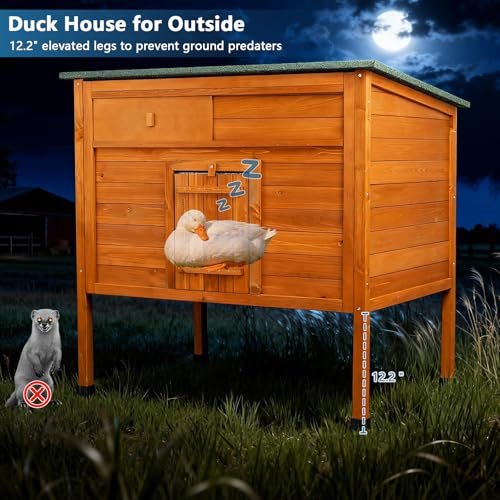
Placement matters more than most buyers anticipate. The elevated floor on all four models keeps moisture from wicking up through the base — a meaningful detail in wet climates — but the coop still needs to sit on reasonably level ground. A slight slope toward the front is acceptable and can actually help with drainage around the base. Avoid placing any of these directly under a tree that drops heavy debris; the asphalt shingle roof handles rain and hail without issue, but sustained debris load on the roof panel can stress the hinged sections over time.
The ventilated windows with closeable panels give you control over airflow across seasons — open in summer to prevent heat buildup inside the coop, closed in winter to retain warmth (especially relevant in the insulated models). Poultry, particularly ducks, generate significant moisture through respiration; adequate ventilation prevents that moisture from degrading the interior wood. The non-slip ramp is a detail that matters specifically for ducks, which have a harder time gripping smooth surfaces than chickens do — it's included on all models rather than being a premium-only feature.
Cleaning, Maintenance, and Keeping Wood in Good Shape
The pull-out trays are the feature that determines whether cleaning this coop stays manageable over months and years. All four models include trays that slide out from below the roosting area without tools — remove them, scrape and rinse, slide back in. The chicken coop models also include a removable PVC floor layer directly beneath the birds, which captures waste before it contacts the wood frame and extends the time between deep cleans. Replace or wipe down the PVC layer on your regular cleaning schedule — weekly for most small flocks — and the underlying wood stays dry and structurally sound.
Like any wooden outdoor structure, these coops benefit from an annual weatherproofing coat applied to the exterior wood panels, particularly the base edges and any surfaces that face prevailing rain. The asphalt shingle roofs don't require additional treatment, but the side panels and the ramp will absorb moisture over time if left untreated. Use an exterior wood sealant rated for animal-safe use after curing — this is especially important in the Pacific Northwest, the Gulf Coast, or anywhere that sees sustained wet seasons. Buyers who skip this step typically notice surface checking and minor warping in the second or third year; those who do it report the coops holding up well past that.
- Weekly: Pull and clean the trays; wipe down the PVC floor layer (chicken models); check the ramp for debris buildup.
- Monthly: Inspect latch hardware and door hinges for rust or loosening; tighten any screws that have worked free from normal use.
- Annually: Apply exterior wood sealant to side panels, ramp, and base edges; inspect the roof panel seams for any gaps that have developed and reseal with exterior caulk if needed.
- Before winter: Close ventilation panels to reduce heat loss (insulated models especially); confirm all latches engage fully, since predator pressure often increases in cold months when natural food sources are scarce.
The insulated models add foam between the wall layers, which improves thermal performance but also means any moisture that gets into the wall assembly through a gap takes longer to dry out. Keep panel joints well-sealed and don't let standing water pool around the base — both points apply to the standard models too, but matter slightly more for the insulated builds.
Frequently Asked Questions
How many birds will actually fit in these coops?
The duck coop models (41.5–41.7 inches long) comfortably house 2–3 ducks, bantam chickens, or quail as overnight sleeping quarters. The chicken coop models (55.2 inches long) are sized for 1–2 standard-breed laying hens. These are sleeping and shelter dimensions — not run dimensions. All four models work best paired with a separate attached run or free-range time during the day; they're not designed as all-day confinement spaces for any number of birds.
What's the difference between the insulated and standard models beyond the price?
The insulated models (PD-1031W-Y and PD-1032W-R) add foam insulation built into the wall panels — the same design approach FunXplore uses in its insulated dog kennels, where foam is sandwiched between double wood layers. The footprint and exterior dimensions are nearly identical to the standard versions (41.7 vs. 41.5 inches long for the duck coops; identical dimensions for the chicken coops), but the insulated duck coop weighs 7.4 lbs more and the insulated chicken coop weighs 6.7 lbs more, reflecting the added material. In practical terms: if your overnight low temperatures regularly drop into the 20s°F or below, the insulated build makes a real difference in interior warmth retention. If you're in a zone that rarely sees hard freezes, the standard build handles rain and wind effectively without the added weight.
Can the chicken coop actually work as a rabbit hutch?
Yes — both chicken coop models (PD-1032-R and PD-1032W-R) list multi-species use including rabbits, and the removable PVC floor layer and ventilated windows are practical for rabbits on supervised outdoor time. At 55.2×29.6 inches of floor space, it's on the larger end for a hutch. The same honest caveat applies here that applies to all hutches in this size range: the r/Rabbits community's position is that hutches of this footprint aren't adequate as full-time primary housing for most rabbit breeds. Used as a supervised outdoor enclosure or secure sleeping shelter with daily exercise time outside, it works well. The nesting box section functions as a hide space for rabbits, which most rabbits will use readily.
How hard is assembly, and do I need two people?
Yes, plan for two people. The assembled weights range from 59.9 lbs (standard duck coop) to 81.3 lbs (insulated chicken coop), and the panel-based construction requires holding sections in alignment while fastening — difficult to do solo without the panels shifting. Assembly time for most buyers runs 2–3 hours for the duck coops and 3–4 hours for the larger chicken coop models. Take the time to fully seat each screw and align the roof panel flush before final tightening — even a small gap at the roof seam becomes a drip point after a season of rain. The finished structure, once properly assembled, doesn't need to be disassembled seasonally.
Does the asphalt roof actually hold up in real weather, or is it just marketing?
Based on the construction — fiberglass mat coated in asphalt and mineral granules, the same basic material used on residential roofing — it sheds rain without pooling and handles hail without tearing the way tarp-style roofs on competing coops can. It won't blow off in gusts the way a fabric cover might. That said, like any outdoor structure, inspect the roof panel seams annually and reseal any gaps that have developed with exterior caulk. The roof itself doesn't require additional treatment, but the wood side panels around it benefit from a weatherproofing coat before the first winter season.
Is the ramp non-slip enough for ducks specifically?
The non-slip ramp is included on all four models and is specifically relevant for ducks, which have more trouble gripping smooth surfaces than chickens do due to their flat, webbed feet. The ramp surface provides enough grip for normal entry and exit on a typical coop-height ramp angle. One practical note: if you're keeping ducks in a wet climate where the ramp surface stays damp, check it periodically and add grip tape or wood cleats to any section that shows wear. Ducks are heavier-bodied than chickens of similar size and put more load on the ramp over time.